
How Much Does Attic Air Sealing Cost in Fremont?
Attic Air Sealing services in Fremont, CA typically cost between $1,200 and $3,800 for a standard single-family home, with most Fremont homeowners paying around $1,800 to $2,400 when the attic has moderate leakage and straightforward access. The wide range comes down to attic size, the number and severity of penetrations (think recessed lights, top plates, plumbing chases), and whether the existing insulation needs to come out first – a common situation in older Niles District and Centerville-area homes built before 1985.
Attic Air Sealing Cost Breakdown (2026)
Here’s how pricing typically breaks out for Fremont homes. These are real numbers from jobs we’ve completed in this market, not national averages padded with disclaimers.
| Service Component | Typical Cost Range | Notes |
|---|---|---|
| Base attic air sealing (up to 1,200 sq ft) | $1,200 – $1,800 | Sealing top plates, penetrations, dropped soffits |
| Mid-size attic (1,200 – 2,000 sq ft) | $1,800 – $2,600 | Most Fremont ranch and two-story homes fall here |
| Large attic (2,000 sq ft+) | $2,600 – $3,800 | Larger footprints common in Ardenwood and Mission San Jose |
| Spray foam at critical penetrations (add-on) | $200 – $600 | Two-part closed-cell foam at chases, chimneys, knee walls |
| Insulation removal before sealing (per sq ft) | $1.00 – $1.75/sq ft | Required when existing batts block penetration access |
| Reinstallation of blown-in insulation post-seal | $0.85 – $1.50/sq ft | GreenFiber or Knauf blown cellulose or fiberglass |
| Blower door test (pre and post) | $150 – $350 | Confirms the work actually reduced air leakage |
| Full home energy audit (diagnostic starting point) | $200 – $450 | Identifies exactly where air is escaping before any work begins |
The single biggest pricing variable we see in Fremont is attic access and condition. A 1,600 sq ft attic with a standard hatch, good clearance, and no rodent damage is a clean job. That same footprint in a 1960s Irvington home with a low-pitch roofline, blown-in insulation covering everything, and original knob-and-tube wiring in the joist bays is a different job entirely – it takes more time, more material, and more care. Upfront pricing means you’ll know the full number before we start, not after.
One thing worth knowing: because Fremont sits in Alameda County’s Climate Zone 3 (coastal-influenced, with cool marine air most of the year and occasional inland heat spikes from the Tri-Valley direction), the building science case for air sealing is unusually strong here. Your attic isn’t just losing heat in winter – it’s pulling in humid coastal air year-round, which degrades insulation over time and drives mold risk up. Sealing the envelope pays back faster here than in a purely dry inland climate.
What Affects Attic Air Sealing Pricing in Fremont
- Attic square footage and geometry: Larger attics cost more, but shape matters just as much as size. Low-slope rooflines common in 1950s and 1960s Fremont tract homes (particularly in the Glenmoor and Centerville neighborhoods) reduce working height, slow the job, and increase labor time. A cramped attic with three-foot clearance in the center takes longer to seal properly than a vaulted space twice its size.
- Number of penetrations: Every recessed light can, every plumbing vent, every HVAC chase, every electrical wire penetrating a top plate is a potential air leak. Older Fremont homes – especially those built during the 1960s-1980s suburban expansion – often have dozens of recessed can lights that are notoriously leaky. We’ve found attics in the Niles District with over 40 separate penetration points. More penetrations means more labor and more material.
- Existing insulation condition: If the current insulation is clean and undisturbed, we can sometimes seal around it. But if it’s contaminated with rodent waste (a real issue in Fremont’s older neighborhoods near the hills, where rats and squirrels are active), compacted, moldy, or covering penetrations we need access to, it has to come out first. Removal adds cost but skipping it compromises the seal quality.
- Spray foam requirements: Not all penetrations seal the same way. Large gaps at top plates, chimney chases, and plumbing chases require two-part closed-cell spray foam – a material from brands like Icynene or Demilec that expands, seals, and holds its shape. Smaller gaps get caulk or foam backer rod. Attics with more large-format gaps will cost more in materials even if the labor time is similar.
- Home age and construction era: Pre-1978 Fremont homes often have construction details that create bigger air gaps – open wall cavities connecting directly to attic space, no blocking between ceiling joists, dropped soffits above kitchen cabinets that act as open chimneys. Post-2000 homes tend to have tighter framing but sometimes have more complex HVAC penetrations. The build era shapes both labor time and how much material is needed.
- Whether a home energy audit precedes the work: A full diagnostic starting point – our Home Energy Audit – uses a blower door test and thermal imaging to map exactly where conditioned air is escaping. It adds cost upfront, but it means the air sealing addresses the actual problem rather than just the visible penetrations. For Fremont homeowners spending $300+ a month on PG&E bills, the audit typically identifies enough waste to pay for itself in the first year. We recommend it before any major sealing project.
How Fremont’s Climate and Housing Stock Shape the Cost
Fremont isn’t a generic Bay Area suburb when it comes to insulation and air sealing – it has specific conditions that directly affect what jobs cost and what results you can expect.
The city sits at the intersection of three microclimates. The western neighborhoods – Warm Springs, Centerville, and the areas near the bay – get consistent marine influence: cool, humid air most of the year. Mission San Jose and the Ardenwood neighborhoods toward the hills are warmer and drier. The Niles Canyon corridor sees some of the sharpest temperature swings in the area as inland heat moves through. None of these zones match the “California sunshine” stereotype, and each one creates different attic air-sealing priorities.
In the marine-influenced west side, the main concern is moisture-laden air infiltrating the attic and degrading insulation – we see a lot of compressed, damp fiberglass batts that have lost significant R-value in homes that were never properly air sealed. In the Mission San Jose and Ardenwood areas, summer heat gain through a poorly sealed attic is the bigger bill driver. In Niles and the hill-adjacent neighborhoods, both problems show up, along with a higher incidence of wildlife intrusion – squirrels and rats using any gap they can find.
Fremont’s housing stock also skews older than people expect. A large portion of the single-family homes in Centerville, Irvington, and Glenmoor were built between 1950 and 1975, when air sealing wasn’t part of standard construction practice. These homes are prime candidates for air sealing, and they tend to have more penetrations and more complex existing conditions – which is reflected in the mid-to-upper end of the pricing ranges above.
Permit Requirements in Fremont for Attic Air Sealing
Straight air sealing work – caulking, foam, and mechanical fasteners at penetrations – does not typically require a building permit in Fremont under California Building Code for existing residential structures. However, if the project involves removing and replacing insulation, adding mechanical ventilation, or modifying the attic’s thermal boundary in a way that affects HVAC system sizing, a permit may be required. Fremont’s Building and Safety Division follows the California Residential Code, which aligns with Title 24 energy standards.
If you’re doing air sealing as part of a larger renovation – adding a conditioned attic space, spray-foaming the roof deck instead of the floor, or converting an attic to living space – permits are required and the work will need to meet current Title 24 compliance. We’ll flag anything permit-relevant during the estimate so there are no surprises after the job starts.
How to Save on Attic Air Sealing
The most direct way to reduce the cost of attic air sealing in Fremont is to start with an accurate diagnosis rather than a guess. When homeowners call us after getting a previous quote that felt high, we often find the other contractor was quoting work that wasn’t needed – or missing the actual leakage points and underquoting for the wrong job. A proper Attic Air Sealing in Fremont assessment finds the real problem first, so you’re not paying for work that doesn’t move the needle on your energy bills.
Combine Services in a Single Visit
If your attic needs both air sealing and new insulation, doing them together in one visit cuts total cost compared to scheduling two separate jobs. The insulation has to be moved or removed anyway to access the penetrations, so having us reinstall blown-in material – using GreenFiber cellulose or Knauf blown fiberglass – at the same time adds far less in labor than a return trip would. Most jobs at Warmline are completed in a single visit, and combining services is a big part of how that works.
Check PG&E Rebates and TECH Clean CA
California’s TECH Clean California program and PG&E’s energy-efficiency rebate programs both cover attic insulation and air sealing measures in some circumstances. Rebate eligibility depends on current program funding (which changes quarterly) and whether the work is paired with other qualifying upgrades. We’ll let you know at the estimate stage what’s currently available – but don’t count on a specific rebate until you verify current availability with PG&E directly, since these programs open and close faster than most homeowners expect.
Use the Current Discounts
Warmline’s standing offers apply to this work. If you’re a senior or veteran, the 5% discount applies automatically – just mention it when you call. Jobs over $250 in repairs qualify for $50 off. These aren’t promotional prices that expire next week; they’re permanent offers that reduce the out-of-pocket cost on nearly every job we do in Fremont.
Don’t Wait Until It’s Urgent
Attic air sealing priced and scheduled proactively – not after a crisis like a major rodent infestation or a failed HVAC inspection – costs less because it’s just the air sealing job. Emergency remediation, rodent cleanup, and contaminated-insulation removal all add to the bill significantly. A home that gets sealed before the problems compound is almost always a simpler, cheaper job.
Call (510) 953-5663 for a free estimate. A live person answers every time – no voicemail, no callback queue. We’ll give you a number before anything starts.
Is Attic Air Sealing Worth It in Fremont?
For most Fremont homes built before 1990, yes – by a significant margin. Here’s the practical math: a house losing conditioned air through attic penetrations is running its HVAC system harder than it needs to, all year. In a Climate Zone 3 home, the heating load is moderate but nearly continuous from November through April. A well-sealed attic typically reduces heating and cooling energy use by 15-30% according to Department of Energy data on air sealing effectiveness in similar climate zones.
For a Fremont household spending $250-$350 a month on PG&E (a realistic number for a 1,600-2,000 sq ft home on a gas-plus-electric plan), that’s $450-$1,260 in annual savings. At a project cost of $1,800-$2,400, the payback period runs two to five years – and the work continues saving money for the life of the house. The building itself is also in better condition: less moisture infiltration, less pest access, and less thermal cycling stress on the structure.
The homes where the math is most compelling are older Irvington and Centerville properties with original construction – little to no top-plate sealing, open cavities everywhere, and recessed lights that might as well be small holes in the ceiling. We’ve done post-sealing blower door tests on Fremont homes where air changes per hour dropped by more than 40%. That’s a real, measurable improvement, not an estimate.
What the Attic Air Sealing Process Looks Like
Knowing what to expect on the day of the job removes a lot of the friction homeowners feel about scheduling work like this. Here’s how a typical Fremont air sealing job runs from our end.
Step 1: Assessment
Before any material touches your attic, our technician does a full walk-through – attic inspection, visual review of existing insulation, penetration count, and a review of your energy bills if you want to share them. If you’ve opted for a Home Energy Audit, this phase includes a blower door pressurization test that quantifies exactly how leaky the house is. The audit is the diagnostic starting point that makes every other service smarter – it tells us where the air is actually going, not just where we’d expect it to go based on the building’s age.
Step 2: Insulation Staging
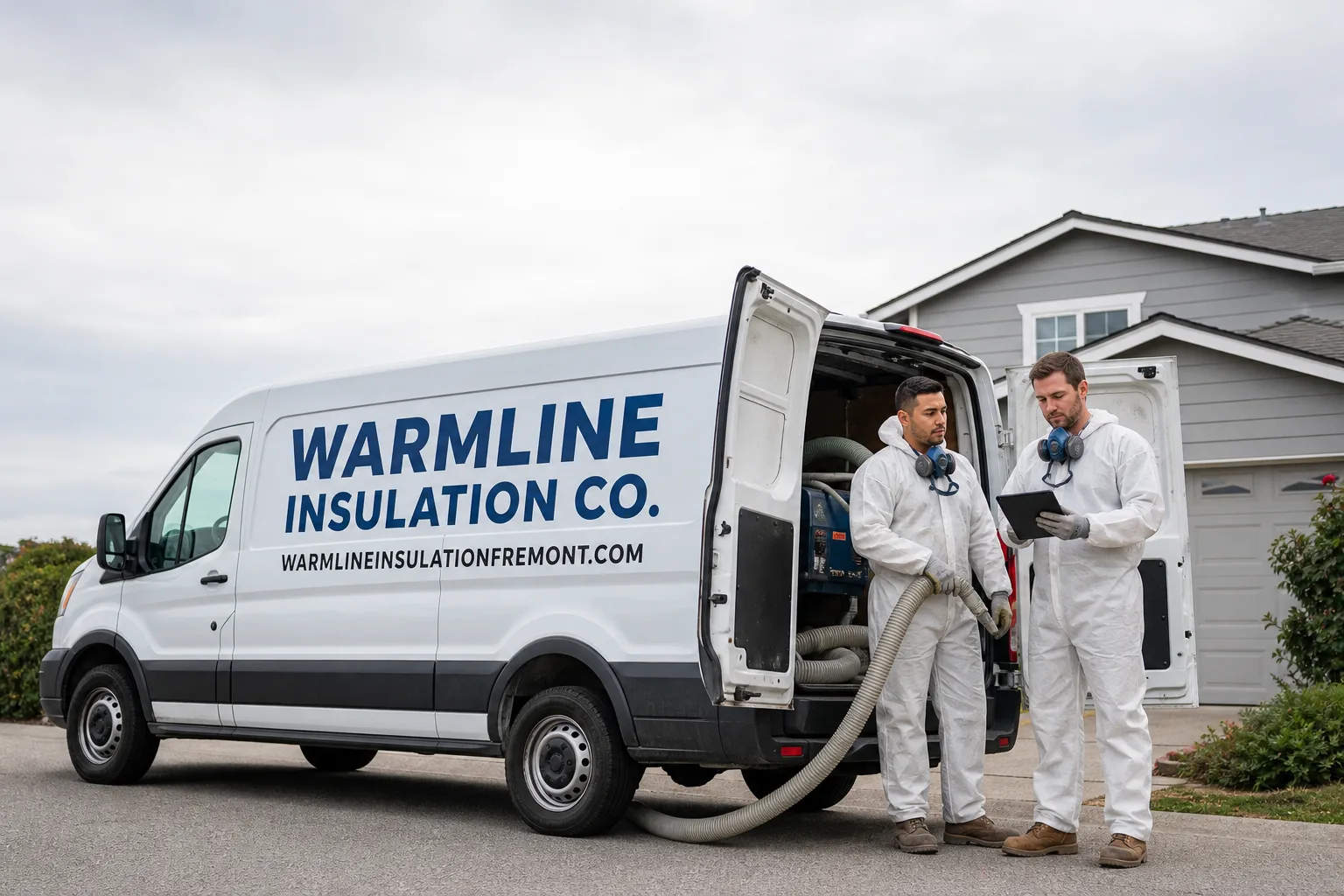
If existing insulation covers the penetrations we need to access, it gets carefully moved or removed. In cases where the insulation is contaminated or past its useful life, removal is the right call – and the home ends up in better shape for it. We use commercial-grade vacuum equipment for removal and keep the work area clean inside the house.
Step 3: Sealing
Top plates, wall cavities open to the attic, plumbing and electrical penetrations, dropped soffits, recessed light housings, and chimney chases all get sealed with the appropriate material. Large gaps get two-part closed-cell spray foam from Icynene or Demilec. Smaller penetrations get low-expansion foam or fire-rated caulk. The goal is zero visible pathways between conditioned space and attic air.
A quick safety note on this phase: if your home has knob-and-tube wiring, open junction boxes, or other electrical hazards in the attic, we’ll flag those before sealing around them. Applying spray foam over live electrical components isn’t just a code issue – it’s genuinely dangerous. We don’t skip that step, and we’ll tell you what we found before the job continues.
Step 4: Insulation Reinstallation
Once the attic is sealed, blown-in insulation goes back in to California Title 24 standards for Climate Zone 3. We use Knauf or GreenFiber blown cellulose or fiberglass depending on the application – both are benchmark materials with real thermal performance data behind them. The finished attic should hit R-38 to R-60 depending on your home’s existing conditions and upgrade goals.
Step 5: Post-Verification
On jobs that included a pre-sealing blower door test, we do a post-sealing test to confirm the air changes per hour actually dropped. This is the accountability step most contractors skip. It’s how we back the 90-Day Done Right Promise with a number.
FAQs – Attic Air Sealing Cost in Fremont
How much does attic air sealing cost in Fremont, CA?
Attic air sealing in Fremont costs between $1,200 and $3,800 for most single-family homes, with the majority of projects landing in the $1,800-$2,400 range. The low end applies to smaller, easily accessible attics with moderate leakage. The high end reflects larger homes, extensive penetrations, or situations where existing insulation needs to be removed and reinstalled. Call (510) 953-5663 for a free estimate specific to your home – a live person will answer.
How long does attic air sealing take?
Most Fremont air sealing jobs are completed in a single day – typically four to eight hours depending on attic size and complexity. A 1,400 sq ft attic with standard penetrations and no insulation removal usually takes four to five hours. Add insulation removal and reinstallation and the same attic runs seven to eight hours. We schedule around that reality and give you a time window upfront.
Does attic air sealing require a permit in Fremont?
Standard attic air sealing – sealing penetrations, top plates, and bypasses with caulk and foam – does not require a permit in Fremont for existing residential structures under current California Building Code. Permit requirements do apply if the scope includes modifying the thermal boundary, converting to a conditioned attic, or combining the project with HVAC work. We’ll confirm permit requirements during your estimate so there are no surprises.
Is it cheaper to repair or replace attic insulation before air sealing?
If existing insulation is intact and uncontaminated, sealing around it (or moving it temporarily) is cheaper than full replacement – typically saving $0.85-$1.50 per square foot in reinstallation cost. But if insulation is rodent-contaminated, moldy, or compressed below useful R-value levels (a common finding in Fremont homes built before 1980), removing and replacing it is the smarter investment. Sealing an attic and then leaving degraded insulation in place doesn’t get you the full benefit of the work. We’ll give you an honest read on what your attic actually needs.
Can attic air sealing reduce my PG&E bill?
Yes – typically by 15-30% on heating and cooling costs for Fremont homes with significant attic air leakage. In real dollar terms, a household spending $300 a month on energy bills can expect to save $540-$1,080 per year after a properly executed air sealing project. The payback period on most Fremont jobs runs two to five years, after which the savings are pure return. The clearest way to know what your specific home will save is a pre-sealing blower door test, which quantifies exactly how leaky the house is before we start. Call (510) 953-5663 to talk through whether an audit makes sense for your situation.
What’s included in Warmline’s 90-Day Done Right Promise?
The 90-Day Done Right Promise means that if the work isn’t right within 90 days of completion, we make it right – at no additional cost. This is a written commitment, not a verbal assurance, and it applies to every attic air sealing project we complete in Fremont. It’s the kind of backing that only makes sense if the work is done correctly the first time, which is why we use a post-sealing blower door test to confirm actual performance rather than just assuming the result was good.
Key Takeaways
- Attic air sealing in Fremont runs $1,200 to $3,800, with most homes landing at $1,800-$2,400.
- Attic size, penetration count, and whether existing insulation needs removal are the biggest price drivers.
- Fremont’s Climate Zone 3 conditions – coastal humidity, mild but persistent winters – make air sealing unusually cost-effective here compared to drier inland markets.
- Older homes in Centerville, Irvington, Niles, and Glenmoor typically need more extensive sealing due to 1960s-1980s construction practices.
- A Home Energy Audit is the right diagnostic starting point before any major sealing project – it finds the actual leaks, not just the expected ones.
- California rebate programs (PG&E, TECH Clean CA) may offset project cost depending on current program availability.
- Senior and veteran homeowners get a permanent 5% discount on every Warmline project.
- All work is backed by the 90-Day Done Right Promise – if it’s not right, we make it right.
Ready to Stop Losing Money Through Your Attic?
Warmline Insulation Co. has been doing this work in Fremont since 2011. Neil Ashford and the team know this city’s housing stock, its climate quirks, and exactly what it takes to seal an attic properly the first time. Our technicians are background-checked and uniformed, pricing is upfront with no surprises, and most jobs are done in a single visit. If you’re a senior or veteran, mention it when you call – the 5% discount applies automatically.
Call (510) 953-5663 for a free estimate. A live person answers every call, 24/7 – no voicemail, no callback queue. We’ll tell you exactly what the job involves and what it will cost before anything starts.
Pricing reflects the Fremont market as of 2026. Warmline Insulation Co. offers free estimates – call (510) 953-5663.
Written by Neil Ashford, Owner at Warmline Insulation Co., serving Fremont since 2011.
What Our Customers Say
"Radiant barrier stapled to the rafters plus new baffles at the soffits. Attic temperature dropped enough that the AC runs noticeably less in the afternoon. Crew was in and out in a day and left the garage cleaner than they found it."
- Sam Kessler"Upstairs was ten degrees hotter than downstairs every summer. They pulled the attic to bare joists, air-sealed every can light and top plate first, then blew it to R-49. First August in this house where the bedrooms and the living room read the same on the thermostat."
- Marcus Hale"Rodents had been in the attic for years before we bought the place. They vacuumed everything out, sanitized, sealed the entry points with mesh and foam, and only then put new insulation down. Photos of every stage before I paid."
- Darnell Whitfield