
How Much Does Wall Insulation Cost in Fremont?
Wall insulation in Fremont, CA typically costs between $1,200 and $4,500 for a standard single-family home, with most projects landing around $1,800 to $2,800 depending on wall area, insulation type, and whether the walls are open or closed. Blown-in insulation for existing closed walls runs $1.50 to $3.00 per square foot, while open-wall spray foam or batt installation ranges from $1.00 to $2.50 per square foot. Most Warmline Insulation Co. jobs are completed in a single visit, with upfront pricing and no surprises.
Wall Insulation Cost Breakdown (2026)
These ranges reflect actual project costs we see in Fremont and the surrounding Tri-City area. Prices include labor, materials, and basic prep – not demolition or drywall repair, which we’ll flag in your estimate if they apply.
| Insulation Type / Method | Best For | Cost Per Sq Ft | Typical Project Total |
|---|---|---|---|
| Blown-in fiberglass (existing closed walls) | Retrofit older Fremont homes without opening walls | $1.50 – $2.75 | $1,200 – $2,400 |
| Blown-in cellulose (existing closed walls) | Retrofit, sound dampening, higher recycled content | $1.60 – $2.90 | $1,300 – $2,600 |
| Fiberglass batts (open walls) | New construction or remodels with open stud bays | $1.00 – $1.80 | $900 – $2,200 |
| Rockwool / mineral wool batts (open walls) | Fire resistance, sound control, moisture tolerance | $1.50 – $2.50 | $1,400 – $3,000 |
| Open-cell spray foam (open walls) | Air sealing + insulation in one pass | $1.80 – $3.00 | $1,800 – $3,500 |
| Closed-cell spray foam (open walls) | Maximum R-value, moisture barrier, structural reinforcement | $3.00 – $5.00 | $2,800 – $5,200 |
| Dense-pack cellulose (retrofit) | Older Fremont craftsman and ranch-style homes | $1.70 – $3.00 | $1,500 – $2,800 |
A few things worth knowing before you read too much into these ranges. Fremont’s housing stock skews heavily toward homes built between 1955 and 1985 – think Mission San Jose ranch-styles, Niles district bungalows, and Centerville-area tract homes. Most of those walls have little or no insulation, and many have the original fiberglass batts that have compressed or settled over 40-plus years. That changes the project scope. A true retrofit into a closed wall requires drilling small holes at each stud bay, injecting dense-pack material, and patching – work that’s more labor-intensive than a new-build batt installation, but far less disruptive than opening the walls entirely.
On the higher end, homes in the Ardenwood area with multiple exterior wall assemblies, or homes near the Dumbarton corridor where marine air exposure accelerates moisture issues, sometimes need closed-cell foam or a vapor management layer that adds cost. We’ll tell you exactly which approach fits your specific walls before any work begins – free estimate, live person on the phone at (510) 953-5663.
What Affects Wall Insulation Pricing in Fremont
No two Fremont homes quote exactly alike. Here are the six factors that move the number most.
- Wall access – open or closed: If your walls are already open (new build, active remodel, or gut renovation), labor costs drop significantly because we work straight from the stud bays. Closed-wall retrofit requires drilling, injection, and patching at every bay, which adds 30 to 50 percent to the labor line. Most Fremont retrofit projects are closed-wall jobs.
- Square footage of exterior wall area: We price by the square foot of wall surface, not by the room count. A 1,500-square-foot Centerville ranch with low ceilings has far less wall area than a two-story home in the Mission Hills area of similar footprint. We measure carefully – we don’t estimate from satellite images.
- Insulation type chosen: Fiberglass batts sit at the low end; closed-cell spray foam sits at the high end. The right choice depends on your wall depth, moisture exposure, and what problem you’re solving – sound, heat, both. Rockwool from brands like Rockwool and Knauf costs more per square foot than fiberglass but outperforms it in Fremont’s coastal-influenced climate where humidity and fire-season dryness alternate unpredictably.
- Existing insulation condition: If there’s old, damaged, or rodent-compromised insulation already in the walls, it needs to come out before new material goes in. Removal adds cost – typically $0.50 to $1.25 per square foot – but skipping it traps odors, allergens, and moisture against your new material.
- Local permit requirements: Fremont’s building code, administered through the City of Fremont Community Development Department, generally doesn’t require a permit for insulation added to existing walls without structural changes. However, if your project is part of a larger remodel or involves spray foam over a certain thickness, a permit may apply. We handle that conversation for you and will flag it upfront if it changes your cost.
- Air sealing scope: Wall insulation works significantly better when gaps around electrical boxes, plumbing penetrations, and top plates are sealed first. We often recommend pairing wall insulation with targeted air sealing – particularly in older Fremont homes where the top plate gap is a major thermal bypass. Adding air sealing to a wall insulation project typically adds $200 to $600 but can cut the performance gap you’d otherwise leave on the table.
Why Fremont Homes Need Wall Insulation More Than Most
Fremont sits in a unique climate pocket. The hills above Mission San Jose catch cool marine air from the bay, while the flatlands around Warm Springs and Irvington bake in summer afternoon heat that routinely hits the mid-90s. That 20 to 30 degree swing between the hills and the flatlands isn’t just a curiosity – it means wall insulation has to work hard in both directions, keeping heat out in summer and keeping conditioned air in during the cool, damp winters.
What makes Fremont’s situation more specific is the age of the housing stock. The city saw its biggest residential building boom from the late 1950s through the 1970s, largely in response to growth at what was then NUMMI (now Tesla’s Fremont plant) and the broader East Bay expansion. Those homes were built under energy codes that ranged from minimal to nonexistent. Many have 2×4 stud walls with R-11 fiberglass batts – if they have anything at all. R-11 was code-minimum then. Today’s California Building Code Title 24 calls for R-15 to R-21 in climate zone 3, which covers most of Fremont. That gap matters: an under-insulated wall in a Niles district or Irvington home can lose 15 to 25 percent of its conditioned air through the wall assembly alone.
We regularly see in the Warm Springs neighborhood that the south- and west-facing walls show the greatest heat gain in summer, and that homeowners on those sides of the house often run their cooling systems 30 to 40 percent more than neighbors with better wall assemblies. That’s not a guess – it’s what the energy audit data shows before and after insulation upgrades.
If you’d like a full picture before committing to any specific improvement, a home energy audit is the right starting point. It shows exactly where your walls, attic, and crawl space are losing the most energy, so every dollar you spend goes to the highest-impact fix first.
Blown-In vs. Spray Foam vs. Batts: Which Is Right for Your Fremont Home?
Blown-In (Fiberglass or Cellulose) – Best for Most Fremont Retrofits
If your walls are closed and you don’t have a remodel opening them up, blown-in is almost always the most practical approach. We drill a small hole at each stud bay – typically from the exterior or interior depending on the finish – inject dense-pack material, and patch. The whole process is far less disruptive than you’d expect. GreenFiber cellulose and Knauf blown-in fiberglass are our go-to materials here: both fill irregular cavities completely, resist settling, and perform well in Fremont’s mixed-humidity environment.
Cellulose has a slight edge in sound dampening, which matters in the Centerville and Niles areas where homes sit close together on narrower lots. Fiberglass blown-in dries faster if it ever gets wet, which is worth considering for walls near bathroom plumbing or in the Mission San Jose hills where condensation can be a factor.
Spray Foam (Open-Cell or Closed-Cell) – Best for Open Walls and Moisture-Critical Applications
Spray foam from manufacturers like Icynene and Demilec does two things at once: it insulates and it air-seals. That’s its main advantage. In an open-wall remodel, applying open-cell spray foam to the stud bays can get you to R-13 to R-15 while simultaneously closing every gap around electrical boxes and blocking the thermal bypass that batts alone can’t address.
Closed-cell foam goes further – R-6 to R-7 per inch, which means a 3.5-inch 2×4 wall can hit R-21 or better. It also acts as a vapor barrier, which is particularly useful for below-grade walls or for exterior walls on the bay-facing west side of homes in Ardenwood and the Dumbarton corridor. The tradeoff is cost: closed-cell is roughly double the per-square-foot price of open-cell. It’s not always necessary, and we’ll tell you honestly when it is and when it isn’t.
Important note: spray foam application involves chemical reactions that produce heat and off-gassing during installation. This work should always be done by trained applicators with proper equipment – not a DIY project. Our technicians carry the required safety equipment and follow California Air Resources Board protocols on all foam applications in Fremont.
Batts (Fiberglass or Rockwool) – Best for Open Walls on a Budget
If you’re doing a full gut remodel or new addition in Fremont, batts are the most cost-effective option. Owens Corning EcoTouch fiberglass batts at R-15 are a standard choice for 2×4 walls under California’s Title 24. Rockwool Comfortbatt gets you the same R-value with better fire resistance, better sound control, and no itch – meaningful benefits if the walls border a garage, a shared wall with a neighboring unit, or a room where a quiet environment matters.
The catch with batts is installation precision. Gaps, voids, and compression all reduce real-world performance significantly. We cut batts to fit tightly around every outlet, pipe, and blocking member – the kind of detail that makes the difference between a wall that performs at rated R-value and one that delivers half of it.
How to Save on Wall Insulation in Fremont
There are real ways to reduce what you spend without cutting corners on performance.
- Bundle with a concurrent project: If you’re already opening walls for a kitchen remodel, bathroom update, or electrical panel upgrade, the marginal cost of adding insulation at the same time is much lower than scheduling a separate job. We coordinate with your contractor or can work independently on our scope.
- Check PG&E’s rebate programs: Pacific Gas and Electric offers rebates for qualifying insulation upgrades in Fremont through their Energy Upgrade California programs. Amounts change year to year and depend on your home’s baseline conditions, but we’ve seen customers recover $200 to $800 on qualifying wall insulation projects. We’ll tell you what to look for – the home energy audit is often the first step toward documenting eligibility.
- Prioritize the biggest thermal losers first: Not every wall in your Fremont home contributes equally to energy loss. South- and west-facing exterior walls, walls adjacent to unconditioned garages, and walls facing the street typically have the biggest impact on comfort and bills. Insulating those walls first gets you most of the benefit at a fraction of the whole-house cost.
- Use our Senior and Veteran discount: Warmline Insulation Co. permanently discounts every job by 5% for seniors and veterans – no expiration, no fine print. If you qualify, mention it when you call and we apply it to your estimate automatically.
- Take advantage of the $50 Off Any Repair Over $250 offer: If your project involves removing damaged existing insulation before reinstalling, that $50 discount applies. Ask about it when you schedule.
- Get the estimate before committing to a method: Homeowners sometimes assume spray foam is always better and pay for it when blown-in would have solved the problem at half the cost. A free estimate from us gives you a side-by-side look so you can make an informed decision. Call (510) 953-5663 – a live person picks up, and we can usually schedule within a day or two.
Fremont’s Older Homes: A Note on What We Find Inside the Walls
After 15 years of working in Fremont – since 2011 – our team has opened a lot of walls across the city. There are patterns worth knowing if you own a home built before 1985.
In the Irvington district, we regularly find walls that were originally insulated with faced fiberglass batts installed facing the wrong direction – vapor barrier toward the exterior instead of the interior. That reversal traps moisture in the cavity and can lead to mold on the sheathing over time. When we find it, we flag it, show you, and give you the option to address it properly rather than just packing new material on top of a problem.
In Niles and the older parts of Centerville, some homes have walls built with a 1×4 diagonal let-in brace that interrupts the stud bay. Blown-in material handles this well because it flows around the obstruction; batts can’t, so you’d need a spray foam solution or a more involved batt-fitting approach. We see this regularly and plan for it in the estimate – it doesn’t catch us off guard.
Near the Warm Springs BART station area, where some of the newer attached townhomes were built in the 2010s, the walls are often already at code minimum but have poor air sealing at the top plate – the gap where the wall framing meets the attic floor. Sealing that connection point at the wall-attic interface is part of our wall insulation in Fremont scope when it applies, and it makes a meaningful difference in year-round comfort.
What the Project Looks Like Day-Of
Most Fremont homeowners have never had wall insulation done and aren’t sure what to expect. Here’s the honest picture.
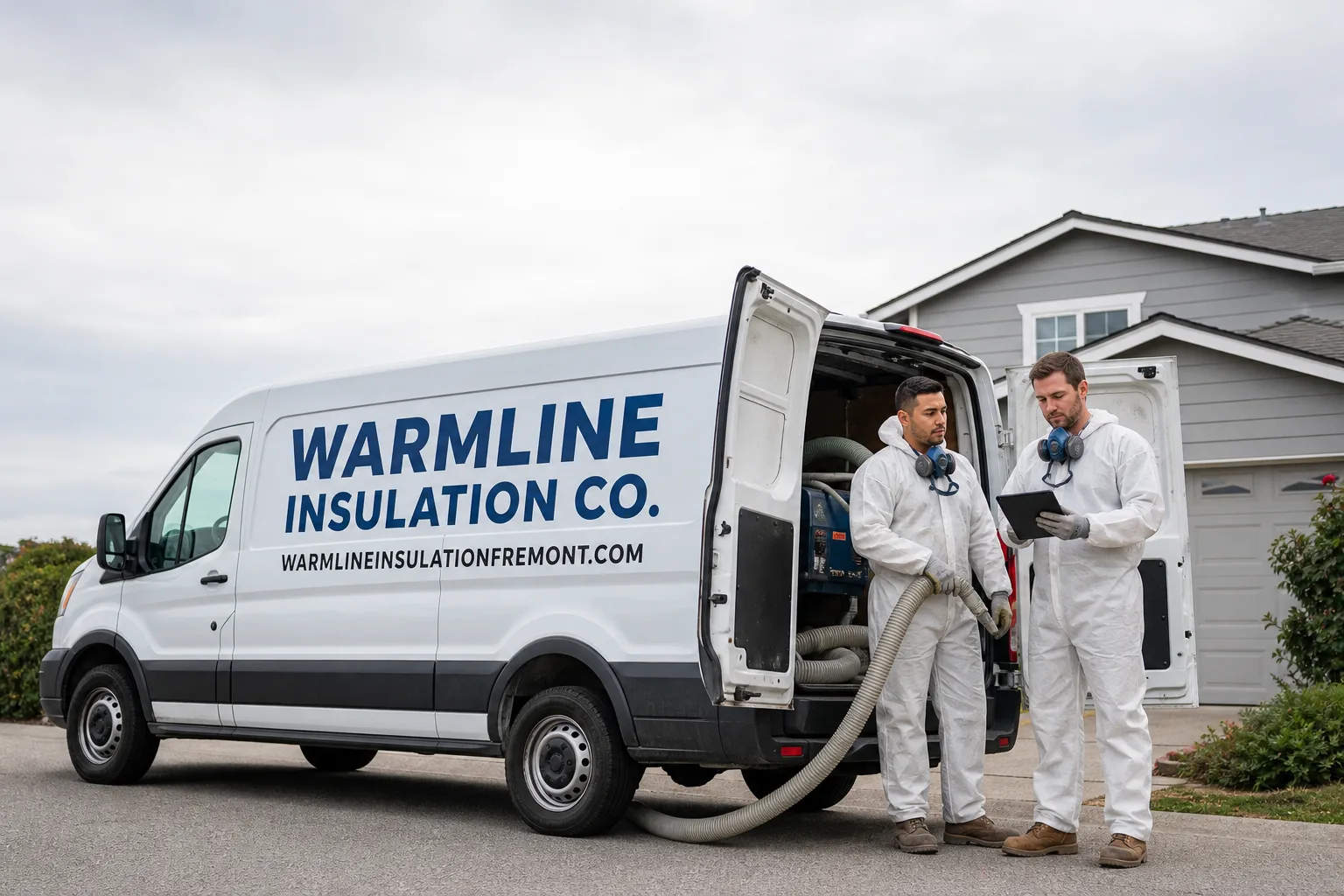
For a closed-wall blown-in retrofit on a typical 1,500-square-foot single-story home, plan on a full day – usually six to eight hours. Our uniformed, background-checked crew arrives with a truck-mounted blower unit, marks the stud bays on the exterior or interior, drills access holes (typically 2 inches in diameter), injects the material under pressure until the cavity is dense-packed, then patches and finishes the holes. On stucco exteriors – common in Fremont – we drill from the exterior, patch with stucco compound, and blend the texture so it’s not obvious where we worked.
For open-wall batt installation during a remodel, the pace is faster – typically a half day to a full day depending on total wall area. Spray foam applications take similar time but require the home to be vacated for four to six hours after application for off-gassing to clear.
Most jobs are completed in a single visit. If something unexpected comes up inside the wall – damaged framing, evidence of moisture intrusion, old knob-and-tube wiring that needs an electrician before we can insulate – we stop, document it, and walk you through the situation before doing anything else. That’s not the exception; it’s standard practice on every job Neil and the team run.
FAQs – Wall Insulation Cost in Fremont
How much does wall insulation cost per square foot in Fremont, CA?
Wall insulation in Fremont runs $1.00 to $5.00 per square foot depending on the method. Fiberglass batts in open walls sit at the low end ($1.00 to $1.80/sq ft), blown-in retrofit work falls in the middle ($1.50 to $3.00/sq ft), and closed-cell spray foam reaches the high end ($3.00 to $5.00/sq ft). For a free measurement and line-item quote specific to your home, call (510) 953-5663.
Is it worth insulating existing walls in an older Fremont home?
Yes, in most cases. Fremont homes built before 1980 typically have R-0 to R-11 in their walls; California’s climate zone 3 targets R-15 to R-21. Closing that gap through blown-in retrofit reduces HVAC runtime, cuts energy bills, and improves room-to-room temperature consistency. Most Fremont homeowners see the investment pay back within four to eight years through reduced PG&E bills, and the comfort improvement is immediate. Start with a home energy audit if you want data before deciding.
How long does wall insulation installation take in Fremont?
Most Fremont wall insulation projects take one full day, and nearly all are completed in a single visit. A small single-story home with accessible wall cavities can finish in five to six hours. A larger two-story home in the Mission San Jose hills with complex exterior finishes might run eight to ten hours. We give you a realistic time estimate when we quote, not a vague window.
Do I need a permit to add wall insulation in Fremont?
For most standard wall insulation retrofits in Fremont, no permit is required. The City of Fremont generally exempts insulation added to existing walls from permit requirements, provided no structural changes are made. Exceptions apply if the work is part of a larger permitted remodel or if spray foam exceeds certain thickness thresholds. We identify permit requirements before any work begins and include any permit costs in your upfront estimate – no surprise fees after the job starts.
Can Warmline Insulation Co. insulate my walls and attic in the same visit?
Often, yes. Because we handle both wall insulation and attic insulation under one roof, we can scope both services, provide a combined estimate, and schedule them together when the project size allows. Bundling services saves you a scheduling trip and can reduce mobilization costs. On larger homes where both scopes are extensive, we may split into two visits – but we’ll tell you that upfront, not after we arrive. Call (510) 953-5663 to discuss what makes sense for your home.
What’s the cheapest way to insulate walls in a Fremont home without major disruption?
The least disruptive and generally lowest-cost approach for closed walls is blown-in fiberglass or cellulose dense-pack, starting around $1,200 to $1,500 for a small single-story home. The access holes are small, the patching is clean, and there’s no need to move furniture or repaint entire rooms. If you’re looking to keep costs down further, prioritizing south- and west-facing exterior walls only (rather than doing the full house at once) gets you most of the thermal benefit at roughly half the price.
Key Takeaways
- Wall insulation in Fremont typically costs $1,200 to $4,500 for a full home, with most single-story retrofits landing between $1,800 and $2,800.
- Blown-in (fiberglass or cellulose) is the right call for most existing closed-wall retrofits; spray foam makes more sense for open walls or moisture-critical applications.
- Fremont’s pre-1980 housing stock is significantly under-insulated by current Title 24 standards – the gap between what’s there and what should be there is where your energy bills disappear.
- PG&E rebates, the 5% Senior and Veteran discount, and the $50 Off Any Repair Over $250 offer can meaningfully reduce out-of-pocket cost.
- No permit is required for most standard wall insulation retrofits in Fremont.
- All Warmline work is backed by the 90-Day Done Right Promise – if it isn’t right, we make it right, in writing.
- Estimates are free, upfront, and specific. A live person answers at (510) 953-5663.
Ready for a Free Estimate? Here’s How to Reach Us
If your Fremont home has rooms that never quite reach the right temperature, energy bills that don’t match the square footage, or walls you know haven’t been touched since the home was built, wall insulation is likely one of the highest-return upgrades you can make. We’ve been doing this work in Fremont since 2011, and we’ve seen what a well-insulated wall assembly does for both comfort and bills in every neighborhood from Niles to Warm Springs.
Call (510) 953-5663 and a live person will pick up – any time, any day. We’ll schedule a free on-site estimate, measure your actual wall area, look at what’s already in the walls, and give you a clear, itemized number before any work starts. No pressure, no vague ranges, no surprises on the invoice. The 90-Day Done Right Promise covers every job we do, and most projects are completed in a single visit.
Seniors and veterans, remember to mention your status when you call – your 5% discount applies to every Warmline job, permanently.
Pricing reflects the Fremont market as of 2026. Warmline Insulation Co. offers free estimates – call (510) 953-5663.
Written by Neil Ashford, Owner at Warmline Insulation Co., serving Fremont, CA since 2011.
What Our Customers Say
"Radiant barrier stapled to the rafters plus new baffles at the soffits. Attic temperature dropped enough that the AC runs noticeably less in the afternoon. Crew was in and out in a day and left the garage cleaner than they found it."
- Sam Kessler"Upstairs was ten degrees hotter than downstairs every summer. They pulled the attic to bare joists, air-sealed every can light and top plate first, then blew it to R-49. First August in this house where the bedrooms and the living room read the same on the thermostat."
- Marcus Hale"Rodents had been in the attic for years before we bought the place. They vacuumed everything out, sanitized, sealed the entry points with mesh and foam, and only then put new insulation down. Photos of every stage before I paid."
- Darnell Whitfield